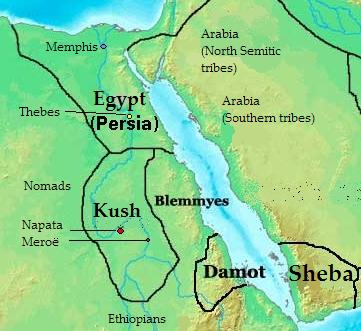
Kingdom of Kush (1070 BC)
With the disintegration of the New Kingdom around 1070 BC, Kush became an independent kingdom centered at Napata in modern northern Sudan. This more-Egyptianized “Kingdom of Kush” emerged, possibly from Kerma, and regained the region’s independence from Egypt. The extent of cultural/political continuity between the Kerma culture and the chronologically succeeding Kingdom of Kush is difficult to determine. The latter polity began to emerge around 1000 BC, 500 years after the end of the Kingdom of Kerma.[citation needed]
The Kush rulers were regarded as guardians of the state religion and were responsible for maintaining the houses of the gods. Some scholars[who?] believe the economy in the Kingdom of Kush was a redistributive system. The state would collect taxes in the form of surplus produce and would redistribute to the people. Others believe that most of the society worked on the land and required nothing from the state and did not contribute to the state. Northern Kush seems to have been more productive and wealthier than the Southern area.
Dental trait analysis of fossils dating from the Meroitic period in Semna, in northern Nubia near Egypt, found that they displayed traits similar to those of populations inhabiting the Nile, Horn of Africa, and Maghreb. Traits from mesolithic and southern Nubia around Meroe however indicated a closer affinity with other sub-Saharan dental records. It is indicative of a north–south gradient along the Nile river.
From Wikipedia, the free encyclopedia